
Discover the top PHP frameworks dominating 2026 and learn which one suits your project based on performance, scalability, and development speed.

PHP is still one of the most powerful and commonly used programming languages for online development. It powers anything from small personal blogs to huge business systems. The best thing about PHP is that it is flexible and has a lot of frameworks that make the development process faster, easier, and more efficient.
These frameworks aid developers by giving them a structured base to work from, cutting down on repetitive activities, and letting them focus on what really matters: creating distinctive application logic. We’ll look at the Top PHP Frameworks in 2026 in this part, breaking out what makes each one unique.
1. Introduction to PHP Frameworks
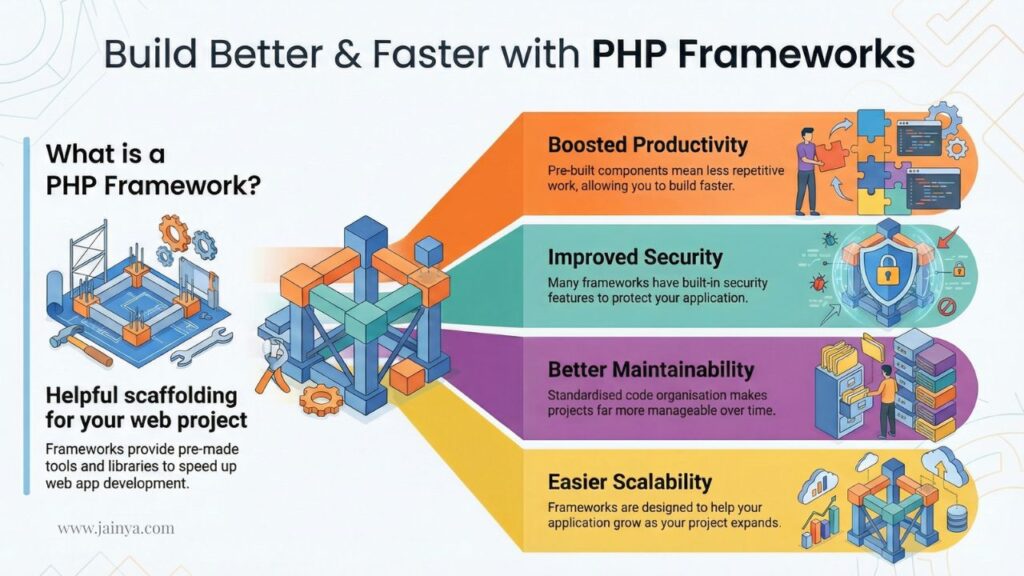
When you use PHP, frameworks are like helping scaffolding that makes the whole process of constructing easier. With a PHP framework, you get a set of pre-made libraries, tools, and parts that speed up the process of making your web apps. They make complicated operations like routing, authentication, database management, and many others easier.
Using a framework gives you the following benefits:
- Boosted productivity: Pre-built components mean less repetitive work for you.
- Improved security: Many frameworks come with built-in security features to protect your application.
- Better maintainability: With standardized code organization, maintaining your project becomes far more manageable.
- Scalability: Frameworks make it easier to scale your applications as your project grows.
There are many different types of PHP frameworks that can meet different purposes. There is a framework for every project, from full-stack frameworks that give you everything you need in one package to micro-frameworks that are made for little apps.
2. Overview of Popular PHP Frameworks
2.1 Laravel
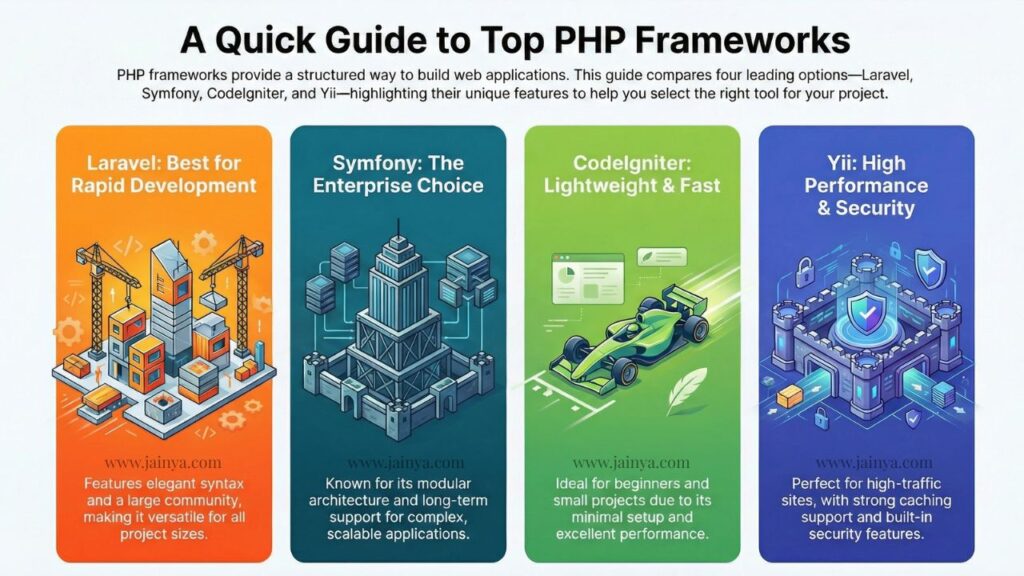
- Laravel is one of the most famous and well-liked PHP frameworks since it has a beautiful syntax and a lot of features. MVC (Model-View-Controller) architecture is used by Laravel to help you properly organize your application. Some of the most important features include the built-in Eloquent ORM, the Blade templating engine, job scheduling, and event broadcasting. These make it easy to develop complicated apps.
- Laravel is a wonderful choice for developers of all levels because it allows for quick development, has a huge community of users, and has outstanding documentation. It works well for everything from small startups to massive enterprise apps.
2.2 Symfony
- If you want to make apps for businesses, Symfony should be on your list of things to look into. Symfony is known for its modular architecture, which lets developers use the same parts in different applications. This makes it more flexible and scalable.
- It is also well-known for its attention on testing and reliability, which makes it great for systems that are important to business. Many popular CMSs, like Drupal, are built using Symfony components.
- Symfony delivers long-term support and excellent enterprise integration for big projects that need strong, safe, and scalable solutions. It’s a great fit for projects with complicated needs.
2.3 CodeIgniter
- CodeIgniter is an excellent choice for people that want something quick and light. It’s perfect for novices and little tasks because it’s easy to use, doesn’t need any setup, and is light. You can rapidly get a project off the ground without having to deal with extra problems because it has a compact footprint and easy routing.
- CodeIgniter is a great choice for constructing small to medium-sized web applications because it has a simple structure and great performance. This means you won’t have to spend time on difficult settings.
2.4 Yii
- Yii means for “Yes, it is!” and it really does deliver on its promise of great performance. This framework has strong cache support, which is important for websites with a lot of traffic. It also has a lot of security features, like input validation and SQL injection prevention. The Gii code generator in Yii can speed up the development process, thus it may be used to make everything from forums to e-commerce sites.
- Yii is a great solution for web apps that get a lot of traffic or deal with private information because it is safe and fast.
3. Framework Specializations
As you learn more about PHP, you’ll see that not all frameworks are the same. Some are better at some things than others, while others are more general.
Here’s a list of the numerous kinds of frameworks you might see:
3.1 Full-Stack Frameworks
- These frameworks provide you everything you need to create a fully working web app, including database administration, templating, and user authentication. Laravel, Symfony, and CakePHP are all full-stack frameworks that give developers everything they need to build a web application.
- Best for: Projects that demand a lot of features, such content management systems (CMS) or e-commerce platforms.
3.2 Micro-Frameworks
- Micro-frameworks like Slim or Lumen are the best choice for small projects, APIs, or when you don’t need a lot of extra effort. These frameworks just handle routing and middleware; the rest is up to you. They’re quick, light, and great for developing APIs or microservices.
- Best for: Small apps that don’t need a full framework. Think about APIs, microservices, or small web apps.
3.3 Frameworks for High Performance
- Performance is very important for websites or apps that get a lot of traffic and need to handle hundreds of requests every second. Frameworks like Phalcon and Yii with caching are built to meet these needs. Phalcon, in particular, stands out since it is a C extension that runs very quickly and uses very little memory.
- Best for: Websites or apps that need to process data quickly and can’t afford to wait, such real-time apps or high-traffic portals.
4. How to Choose the Right PHP Framework
To choose the correct framework, you need to know what your project needs and how experienced your development team is. Here’s a short guide to help you choose the correct one:
- Small Projects & APIs: Go with Slim or Lumen. These micro-frameworks are quick to set up and easy to scale.
- Rapid Prototyping: If you need something fast, Laravel and CakePHP can help you build applications quickly with their built-in tools and scaffolding.
- Large Enterprise Applications: Choose Symfony or Laminas for their robust support for large-scale, enterprise-level systems.
- High-Traffic Systems: For maximum speed and efficiency, Phalcon or Yii will ensure your application performs under heavy load.
Conclusion
There is a PHP framework that is perfect for you, whether you are making a small website, a high-performance application, or an enterprise solution.
Knowing the Top PHP Frameworks in 2026 can help you make a smart choice that saves you time, makes your development workflow better, and makes your site more secure.
If you think about how complicated your project is, how well it needs to work, and how skilled your team is, you’ll be well on your way to picking the right framework for success.
Leave a Comment